What It Takes to Build Research-Ready Networks in Long-term Care Facilities
Clinical research has traditionally centered around clinic-based investigative sites. For many neuropsychiatric populations, especially geriatric, cognitively impaired, or homebound individuals, that model limits participation.
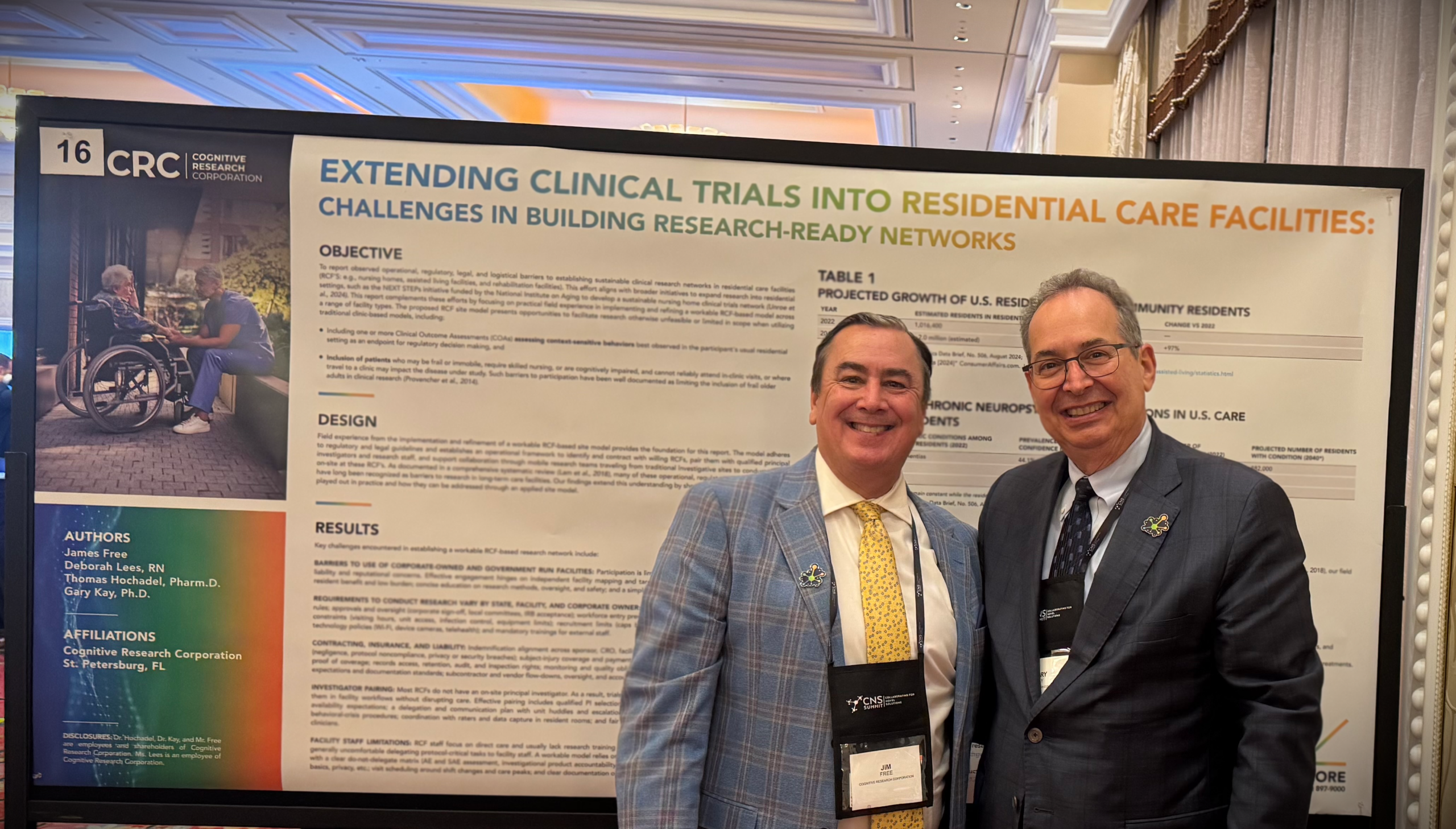
At CNS Summit 2025, the CRC team presented a scientific poster outlining the operational, regulatory, and logistical realities of extending clinical trials into residential care facilities (RCFs), including nursing homes, assisted living facilities, and rehabilitation centers.
The conclusion is grounded in applied experience:
Developing research-ready residential care facility networks is feasible, but it requires a purpose-built operational model that differs from traditional clinic-based approaches.
Why Residential Care Facilities Matter for CNS Research
Residential care communities represent one of the most clinically relevant and historically underrepresented populations in neuropsychiatric drug development. According to recent national data, more than one million individuals reside in U.S. residential care communities, a number projected to approach two million by 2040 [1].
Based on findings from the National Center for Health Statistics Data [2], among these residents in 2022:
- 44% lived with Alzheimer’s disease or other dementias
- 26% lived with depression
- 7% had experienced stroke
If prevalence rates remain consistent, the number of residents living with dementia alone could exceed 882,000 by 2040. These are precisely the populations most often excluded from clinic-based trials due to mobility limitations, cognitive impairment, or travel burden.
For sponsors developing therapies in Alzheimer’s disease, depression, stroke recovery, and related CNS conditions, extending research access into residential settings is not simply an enrollment method but a strategic consideration.
Understanding the Barriers to RCF-Based Research
Establishing sustainable clinical research networks in residential care facilities involves challenges that extend beyond traditional clinic-based models.
As outlined in the CNS Summit poster, key barrier categories include:
- Corporate and government facility restrictions
- Variability in state, facility, and ownership requirements
- Contracting, insurance, and liability alignment
- Principal Investigator availability and integration
- Facility staff capacity and workflow limitations
While many of these challenges have been described in academic literature, the poster reflects how they manifest in real-world settings based on CRC’s direct field experience implementing and refining an RCF-based research model. The full barrier framework and field-based observations are detailed in the full scientific poster.
Why This Matters for Sponsors
When behavioral endpoints are context-sensitive, or when travel itself alters disease presentation, clinic-based assessments may introduce variability that could be mitigated by observing participants in their usual setting.
Research-ready residential care networks expand opportunities to:
- Broaden representation in CNS trials
- Reduce participation barriers
- Support context-sensitive clinical outcome assessments
- Advance development of therapies for under-served populations
Extending clinical trials into RCFs requires regulatory fluency, operational flexibility, and disciplined coordination. It is complex work, but field experience indicates it can be accomplished responsibly.
Download the Scientific Poster
The full scientific poster presented at CNS Summit 2025 provides additional detail on:
- Observed operational, regulatory, legal, and logistical barriers to conducting research in RCFs
- Prevalence and growth data underscoring the importance of these settings
- Conclusions on feasibility and key considerations for developing sustainable RCF research networks
Download the complete scientific poster to explore the full context and findings.
References
- ConsumerAffairs. “Assisted living statistics [2024]” ConsumerAffairs.com. Jan. 25, 2024, https://www.consumeraffairs.com/assisted-living/statistics.html
- National Center for Health Statistics Data Brief, No. 506, August 2024. Available at: https://www.cdc.gov/nchs/data/databriefs/db506.pdf
- Unroe, K., Hickman, S., Levy, C., Zimmerman, S., Floyd, A., & Saliba, D. (2024). NEXT STEPs: Advancing clinical trials research in nursing homes. Innovation in Aging, 8(Suppl. 1), 1373-1374. https://doi.org/10.1093/geroni/igae098.4378
- Provencher, V., Mortenson, W. B., Tanguay-Garneau, L., Bélanger, K., & Dagenais, M. (2014). Challenges and strategies pertaining to recruitment and retention of frail elderly in research studies: A systematic review. Archives of Gerontology and Geriatrics, 59(1), 18-24. https://doi.org/10.1016/j.archger.2014.03.006
- Lam, H.R., Chow, S., Taylor, K. et al. Challenges of conducting research in long-term care facilities: a systematic review. BMC Geriatrics 18, 242 (2018). https://doi.org/10.1186/s12877-018-0934-9